
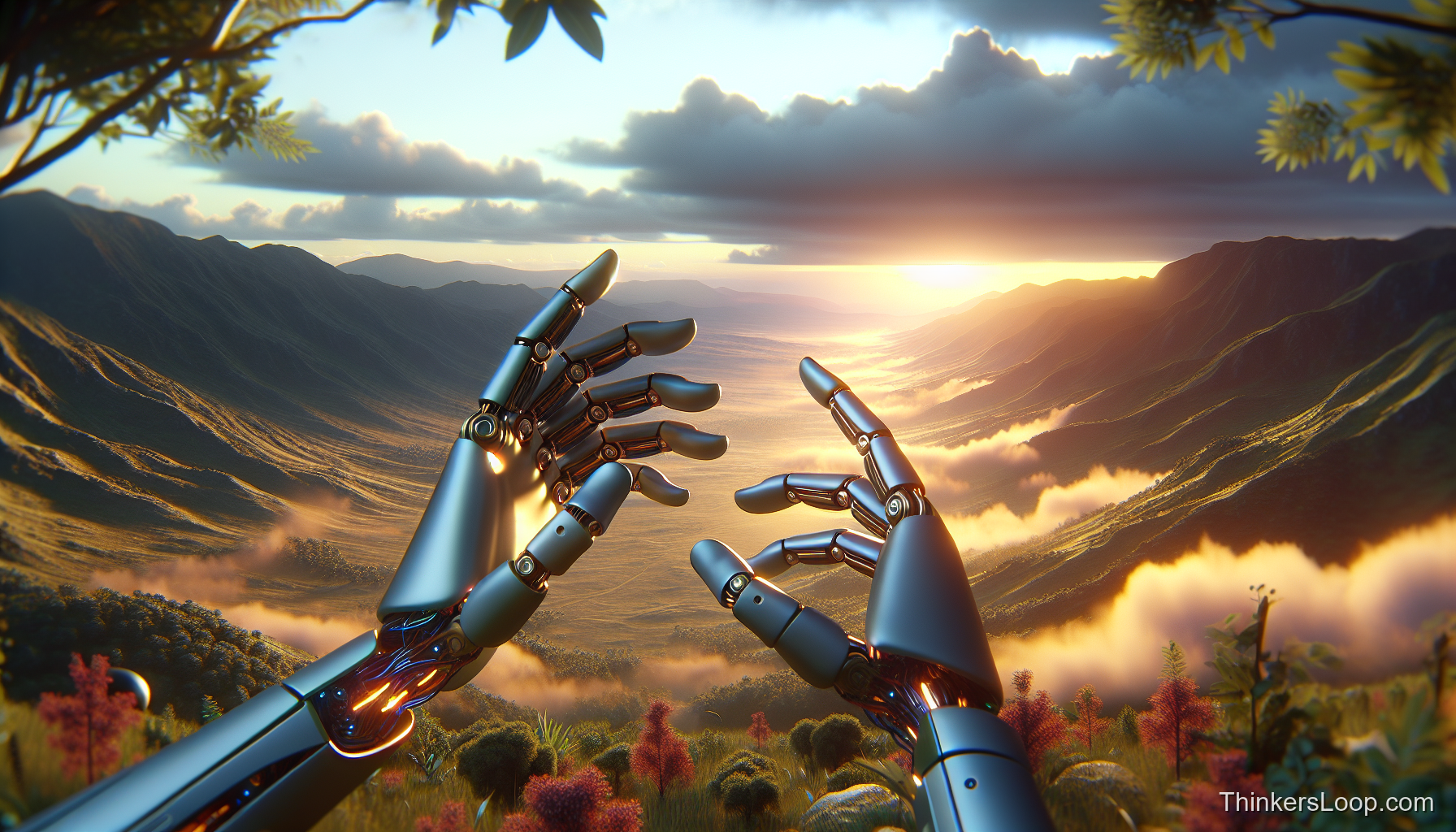
Quick take: AI image generators notoriously produce distorted hands — extra fingers, fused digits, impossible joints. This isn’t a minor glitch; it reveals how these systems work. They learn statistical patterns from images rather than understanding human anatomy. Hands are complex, frequently occluded in photos, and represented inconsistently in training data — making them a perfect stress test of generation-based AI.
If you’ve spent any time with AI image generators — Midjourney, DALL-E, Stable Diffusion — you’ve noticed that they struggle with hands. Five-fingered distortions, extra digits sprouting from palms, fingers that blend together or point in impossible directions — the hand problem is so consistent that “check the hands” became standard advice for spotting AI-generated images.
This failure is illuminating. It’s not a coincidence or a fixable oversight — it reflects something fundamental about how generative AI systems learn and produce images.
How Image Generators Actually Work
Modern AI image generators use a class of model called a diffusion model. During training, the model is shown millions of images paired with text descriptions, with noise progressively added to each image until it becomes pure noise. The model learns to reverse this process — starting from noise and progressively denoising it toward an image that matches a text description. Generating an image means running this denoising process starting from random noise.
This process is fundamentally statistical. The model learns what patterns of pixels tend to co-occur with what text descriptions. It doesn’t build a geometric model of the world — it learns that “person” tends to have pixel patterns in roughly human form, that “tree” has branch-and-leaf pixel patterns, that “hand” has a roughly five-fingered configuration. The output is a statistically plausible image, not a geometrically computed one.
Stable Diffusion was trained on the LAION-5B dataset, which contains approximately 5.85 billion image-text pairs scraped from the internet. Despite this enormous scale, the distribution of hand configurations in training images is skewed: hands are frequently partially visible, foreshortened, occluded, or photographed in unusual angles that make the exact finger count and configuration ambiguous. The model learns that “hand-shaped pixel patterns” can take many forms, without a strong constraint on the number of fingers.
Why Hands Are Specifically Hard
Hands present a unique combination of challenges for statistical image generation. They’re geometrically complex: 27 bones, 29 joints, capable of an enormous range of configurations. They’re frequently occluded in photos — fingers overlap, hands partially disappear behind objects, foreshortening makes fingers look shorter than they are. Professional photography routinely avoids difficult hand poses for exactly this reason. The training data therefore contains many examples of ambiguous or unusual hand configurations.
There’s also a fundamental tension between local and global consistency. A generative model builds images through a denoising process that operates at multiple scales. At the global scale, a person has roughly human proportions. At the local scale of a hand, the model needs to maintain consistency across individual fingers — the right number, the right joints, connecting correctly to the palm. The statistical patterns the model has learned don’t necessarily enforce the geometric constraints that make hands anatomically plausible.
The same generation process that struggles with hands also struggles with text in images, reflections, and any object requiring internally consistent structure. Text rendered in AI images is often garbled because the model learned that text-like pixel patterns appear in certain contexts without learning the specific letter forms that constitute coherent text. Mirrors and reflections are frequently wrong because geometric consistency between an object and its reflection requires spatial reasoning the model doesn’t perform.
What Has Improved and What Hasn’t
Hand generation has improved substantially with each model generation. DALL-E 3 and recent Midjourney versions produce acceptable hands significantly more often than their predecessors. This improvement came from a combination of better training data curation (more, cleaner examples of hands), improved model architecture, and targeted fine-tuning on hand images. The failure mode hasn’t been eliminated — it still appears regularly, especially in complex or unusual hand poses — but it’s less frequent and less severe.
The pattern of improvement is instructive: throwing more data and compute at the problem produces incremental improvement rather than fundamental change. This is characteristic of statistical learning — you can get better at the common cases in the training distribution, but edge cases and configurations underrepresented in training data remain difficult. Perfect hand generation would require either perfect training data coverage (impossible) or a fundamentally different approach that incorporates geometric understanding of human anatomy.
For practical AI image generation, hands can be managed with workflow adjustments. Specifying “hands hidden” or “hands not visible” in prompts avoids the problem entirely. When hands are needed, generating at higher resolution (where the model has more pixels to work with) and using inpainting to regenerate just the hand area can produce better results. Some workflows include hand-specific fine-tuned models for consistent results.
What This Reveals About AI Understanding (or the Lack of It)
The hand problem illustrates something important about how AI image generation differs from human art creation. A human artist drawing hands has a mental model of hand anatomy — bone structure, joint positions, how fingers connect to the palm — and applies that model when rendering hands. When an artist makes a mistake, it’s typically because they misapplied a correct model, not because they don’t know hands have five fingers.
An AI image generator has no such model. It has learned statistical correlations between “hand-like pixel patterns” and the images in its training data. When it generates a plausible-looking hand, it’s because those pixel patterns were statistically common in its training data. When it generates a distorted hand, it’s producing statistically likely output that happens to violate anatomical constraints it doesn’t “know” about. The failure mode itself is the evidence — a system with genuine anatomical understanding would produce anatomically plausible hands because the understanding enforces consistency.
The Broader Lesson for AI Capability Assessment
The hand problem is a useful template for assessing AI capabilities more broadly. When an AI system performs impressively on common cases but fails systematically on specific edge cases or underrepresented inputs, the failure pattern reveals the limits of statistical learning from data. Finding those edge cases — the hands of AI systems in other domains — is more informative than evaluating performance on the tasks the system was designed and tested for.
This applies across AI domains: language models that pass bar exams but fail at common-sense reasoning; medical AI that performs well on majority populations but poorly on underrepresented groups; self-driving systems that perform well in clear conditions but fail in unusual weather or road configurations. Each failure pattern reveals a gap between statistical correlation and genuine understanding.
- Diffusion models learn statistical pixel patterns from training images, not geometric models of anatomy.
- Hands are complex, frequently occluded in training photos, and require local consistency (five fingers, correct joints) the statistical process doesn’t enforce.
- The same failure mode appears with text, reflections, and any object requiring internally consistent structure.
- Improvement over model generations shows statistical learning improves on common cases without fundamentally solving the underlying issue.
- The failure reveals the absence of genuine anatomical understanding — a system with a real hand model would produce anatomically consistent hands.
- Finding the “hands” of any AI system — its systematic edge-case failures — is more informative than evaluating on designed benchmarks.
Frequently Asked Questions
Why specifically hands and not other body parts?
Hands are uniquely difficult because they combine high geometric complexity (27 bones, extreme range of configurations), frequent occlusion in training photos, and strong internal consistency requirements (each hand must have a specific number of properly articulated fingers). Faces are also difficult and have improved similarly over successive model generations. Body parts with simpler geometry or less need for internal consistency (torso, arms) are easier to generate plausibly.
Has the hand problem been fully fixed in newer AI image models?
Significantly improved but not fully fixed. DALL-E 3, Midjourney v6, and Stable Diffusion XL all produce better hands than their predecessors. Unusual hand configurations and specific poses still produce distortions regularly. The improvement reflects better training data and fine-tuning, not a fundamental change in the generation mechanism — which means the underlying constraint violation issue persists.
Can AI image generators be fixed to understand anatomy?
Incorporating anatomical constraints would require either training data curated to enforce anatomical accuracy, fine-tuning specifically on anatomically correct images, or integrating explicit geometric models of human anatomy into the generation process — a hybrid approach. Some specialized medical imaging AI systems use anatomically constrained models for exactly this reason. General-purpose image generators have not incorporated this because it would constrain artistic style flexibility, a trade-off that hasn’t been resolved in mainstream systems.
why AI generates extra fingers, AI image generator hands problem, diffusion model how it works, DALL-E hands issue, AI generated image tell signs, stable diffusion anatomy problems, AI image generation limitations, generative AI statistical patterns