
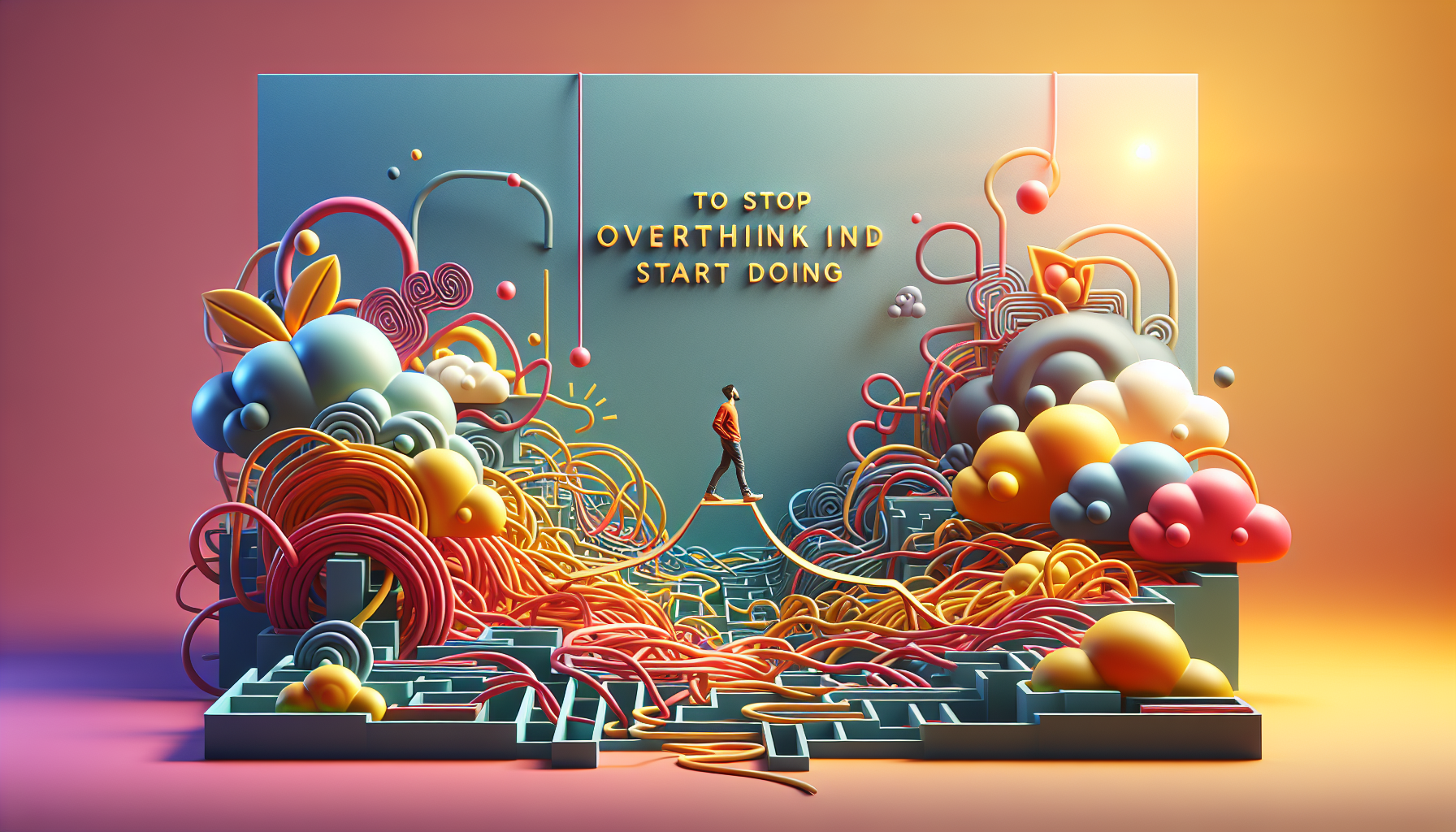
The alarm goes off, and you find yourself lying in bed, already trapped in a web of thoughts. It’s as if each decision presents a new rabbit hole of possibilities, leading to a never-ending cycle of considerations. Before you know it, the day is half-gone, and you’ve made no real progress. The culprit? Overthinking. This mental marathon often masquerades as productivity when, in reality, it’s a barrier to action.
Overthinking can feel like a safety net, a way to shield yourself from making mistakes. However, it often disguises itself as fear of the unknown. Genuine decision-making demands embracing uncertainty, not eliminating it. Consider this: most of the choices that significantly impact our lives involve risks that thinking alone can’t mitigate.
So how do you break free from overthinking and start doing? The answer lies in understanding the traps of your own mind and learning actionable strategies to counter them.
In this article: Why smart people overthink · How to distinguish between useful thinking and spinning · The power of the two-minute decision rule · Transforming action into clarity
Smart People, Big Minds, Overthinking
If you’re a high achiever, your intellect might be your own worst enemy. The skills that drive your success—comprehensive analysis, foresight, attention to detail—can also trap you in a cycle of overthinking. Complex problem-solving abilities allow you to envision numerous scenarios, but they also contribute to analysis paralysis.
Smart people often overthink because their brains are wired to explore every possible outcome.
Consider Barry Schwartz’s findings in his book, “The Paradox of Choice.” He highlights how an abundance of options can lead to decision fatigue, ultimately reducing satisfaction and increasing anxiety. For instance, a software engineer may spend days deliberating over the optimal coding framework, missing tight deadlines and stalling project progress.
Smart individuals often get caught in this loop, creating barriers that prevent them from moving forward. This cognitive overload can lead to a fear of making the wrong choice, without realizing that not choosing is the most significant mistake of all.
Separating Productive Thinking from Overthinking
Think of your thoughts as a bicycle wheel. Productive thinking is the motion propelling you forward; overthinking is the spinning in place. How do you tell them apart? One leads to action, the other to stall.
Research from the University of California shows that 85% of what we worry about never happens.
Imagine a manager who spends countless hours perfecting a presentation, pondering over every slide design and font choice. Instead of enhancing the message, this fixation creates mental clutter and stress. On the contrary, useful thinking would focus on content value and audience engagement, leading to a more impactful presentation.
Knowing when to stop thinking and start acting is crucial. If your thoughts don’t lead to new insights or solutions, it’s time to switch gears and take action.
The Two-Minute Decision Rule
Not all decisions are created equal. For low-stakes decisions, a simple yet effective strategy is the two-minute rule. If a decision won’t impact your life five years down the road, dedicate just two minutes to it. This time constraint compels you to make quicker choices, freeing mental space for more critical issues.
Use a timer on your phone to help enforce the two-minute rule for trivial decisions.
Think of the times you’ve hesitated over what to eat for lunch. Applying the two-minute rule here could save you hours each week. As Amazon’s Jeff Bezos suggests, reserve thorough analysis for decisions that are irreversible and high-stakes, like choosing a business strategy. Meanwhile, streamline the minor ones.
Action Leads to Clarity
When you embrace action as a form of experimentation, you begin to realize that doing often leads to more clarity than thinking. Instead of drowning in hypothetical scenarios, taking a small step forward can illuminate the path ahead.
Action provides real-world feedback that thinking never can.
Picture a startup founder launching a minimum viable product (MVP) rather than waiting for a flawless version. This approach allows them to gather user feedback and iterate based on real-world data. The insights gained from actual user interaction far outweigh those conjured through speculation.
Techniques to Combat Overthinking
Implementing practical techniques can significantly reduce overthinking. By creating a structured approach to decision-making, you can minimize mental clutter and focus on what truly matters. These techniques aren’t just theoretical; they have been tried and tested by professionals across various fields.
| Technique | Best for | How it helps |
|---|---|---|
| Set a decision deadline | Any delayed choice | Forces commitment, prevents indefinite deferral |
| Write the worry down | Repetitive anxious thoughts | Externalizes the loop, reduces mental load |
| Identify the worst case | Fear-driven avoidance | Usually reveals the risk is smaller than imagined |
| Take one small action now | Procrastination on big tasks | Breaks inertia; momentum builds from small starts |
| Limit your options to two | Choice overload | Decision quality doesn’t decline; speed improves dramatically |
Frequently Asked Questions
What is overthinking at its core?
Overthinking is often fear masked as analysis, where the mind spins to remove uncertainty but ends up creating more confusion.
How can I stop overthinking low-stakes decisions?
Use the two-minute rule: if the decision won’t matter in five years, give yourself two minutes to decide and then move on.
What is the best way to gain clarity on a decision?
Taking small actions often provides better insights than overthinking, as reality offers more accurate feedback than imagination.
What tools can help reduce overthinking?
Tools like Trello for task management, Headspace for mindfulness, and journaling apps like Day One can help manage overthinking by organizing thoughts and fostering mindfulness.
The Short Version
- Overthinking masks fear — It often looks like analysis but prevents decision-making.
- Identify spinning thoughts — If no new insights arise after 24 hours, you’re likely spinning.
- Use the two-minute rule — For low-stakes decisions, act quickly and reduce mental burden.
- Action beats planning — Small actions offer better insights than extended planning.
- Set deadlines to decide — The discomfort of choosing is usually less than the cost of delay.
People Also Search For
how to stop overthinking and relax · strategies to overcome analysis paralysis · benefits of taking decisive action · how to prioritize decisions · overcoming fear of failure · improving decision-making skills · the psychology of overthinking · how to increase mental clarity · techniques for better focus · mindfulness and decision-making
Watch: Related Video
Sources
- Iyengar, S. & Lepper, M. (2000). When choice is demotivating. Journal of Personality and Social Psychology.
- Schwartz, B. (2004). The Paradox of Choice. HarperCollins.
- Nolen-Hoeksema, S. (2000). The role of rumination in depressive disorders. Journal of Abnormal Psychology.