
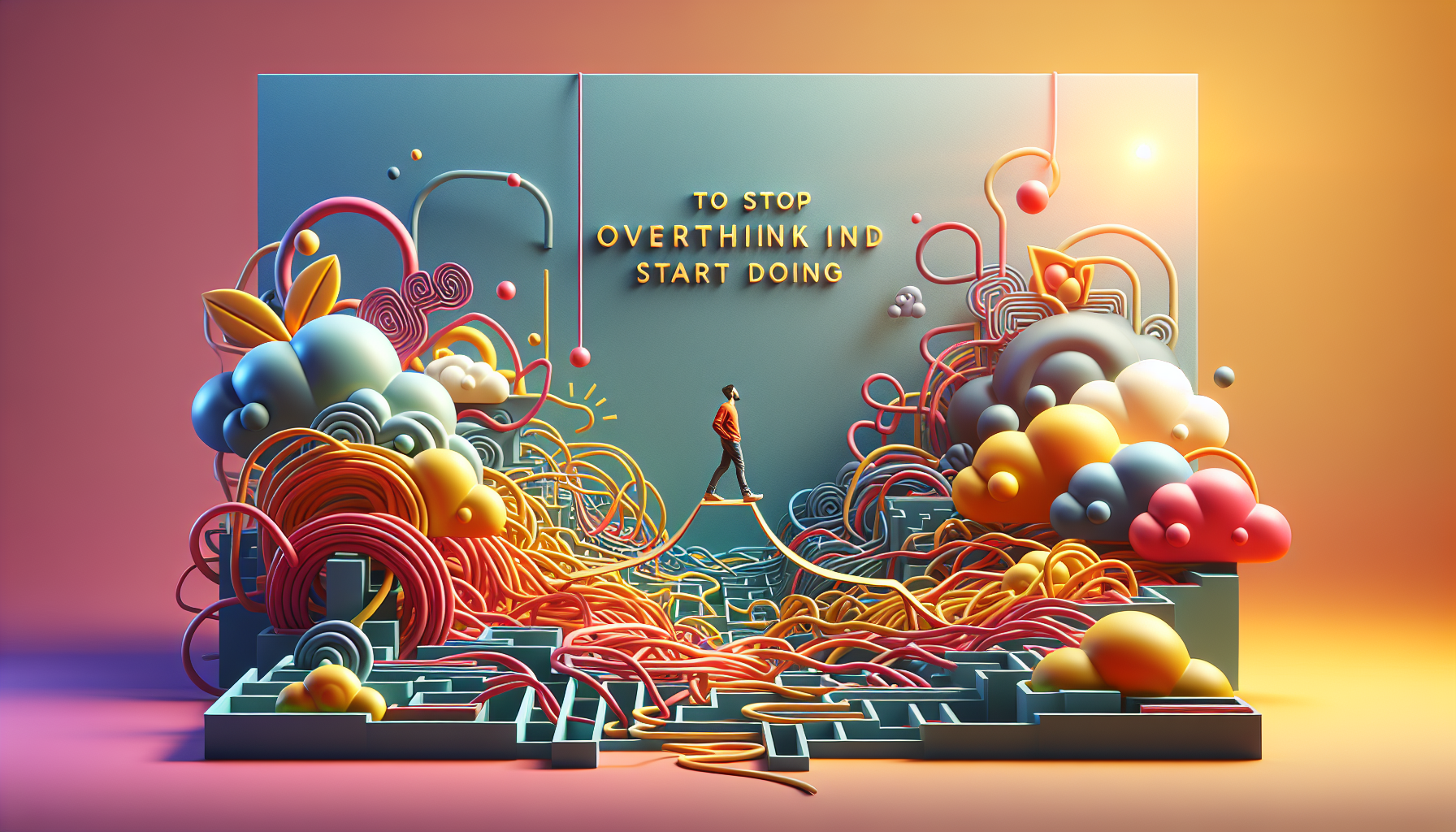
The Loop You Can’t Break Out Of
Overthinking has a particular texture to it. You’re not doing nothing — your brain is working hard, running through scenarios, weighing options, rehearsing outcomes. It feels almost like productivity. But nothing moves. The decisions don’t get made, the work doesn’t get done, and somehow you end up more confused than when you started.
At its core, overthinking is usually fear with a cognitive disguise. The mental looping is the mind’s attempt to eliminate uncertainty before committing to action — a strategy that sounds sensible but fails in practice because most worthwhile decisions involve irreducible uncertainty that no amount of thinking will resolve.
Why Smart People Overthink More
There’s a frustrating irony at the centre of overthinking: the cognitive tools that make someone good at analysis — the ability to generate multiple scenarios, anticipate consequences, notice nuance — are the same tools that fuel analysis paralysis. The mind that’s useful for complex problems applies the same machinery to decisions that don’t require it.
Research by Iyengar and Lepper on choice overload shows that more options consistently produce less satisfaction and lower decision rates. The same dynamic operates internally: the more scenarios you generate, the more overwhelmed your decision-making system becomes. In trying to find the optimal path, you eliminate the ability to take any path at all.
Distinguishing Useful Thinking from Spinning
Not all extended thinking is overthinking. Some decisions genuinely require careful analysis. The question is whether the thinking is producing new information or just recycling the same considerations in different orders. A simple diagnostic: if you’ve thought about this same question for more than 24 hours without reaching a new insight, you’re probably spinning rather than thinking.
Another signal: is the thinking helping you clarify what you want, or is it helping you avoid committing to what you already know you want? Often the information needed for a decision was available early on. The extended deliberation is really about managing the discomfort of choosing — which means committing, which means closing off alternatives, which means accepting that you might be wrong.
The Two-Minute Decision Rule
For low-stakes decisions, a useful rule is simply: if this decision won’t matter in five years, you have two minutes to make it. The time limit forces the mind to work with what it has rather than searching for perfect information. Most low-stakes decisions are reversible, which means the cost of a suboptimal choice is far lower than the cost of the ongoing mental overhead of not having decided.
Jeff Bezos articulates a related framework he calls Type 1 and Type 2 decisions. Type 1 decisions are irreversible and consequential — these deserve careful analysis. Type 2 decisions are reversible and lower-stakes — these should be made quickly. The problem most overthinkers have is applying Type 1 deliberation to what are actually Type 2 decisions.
Action as Information
One of the most underused strategies against overthinking is treating action as a research tool. Instead of trying to think your way to certainty before acting, take the smallest possible action and use what you learn to inform the next step. A writer who spends three weeks planning an article they haven’t started knows less than a writer who spends three hours writing a rough draft — because the draft reveals the real problems.
This approach, sometimes called a “bias for action” in startup culture, doesn’t mean acting impulsively. It means recognising that reality is a better source of information than imagination, and that the fastest path to clarity is often through doing rather than planning.
Practical Techniques That Work
| Technique | Best for | How it helps |
|---|---|---|
| Set a decision deadline | Any delayed choice | Forces commitment, prevents indefinite deferral |
| Write the worry down | Repetitive anxious thoughts | Externalises the loop, reduces mental load |
| Identify the worst case | Fear-driven avoidance | Usually reveals the risk is smaller than imagined |
| Take one small action now | Procrastination on big tasks | Breaks inertia; momentum builds from small starts |
| Limit your options to two | Choice overload | Decision quality doesn’t decline; speed improves dramatically |
Key Takeaways
- Overthinking is usually fear of commitment disguised as careful analysis
- If the same question has circled for 24 hours without new insight, you’re spinning
- Most decisions are reversible — apply the effort level that matches the actual stakes
- Taking small actions generates better information than extended planning
- Set decision deadlines; the discomfort of choosing is almost always lower than the cost of not deciding
Watch: Related Video
Sources
- Iyengar, S. & Lepper, M. (2000). When choice is demotivating. Journal of Personality and Social Psychology.
- Schwartz, B. (2004). The Paradox of Choice. HarperCollins.
- Nolen-Hoeksema, S. (2000). The role of rumination in depressive disorders. Journal of Abnormal Psychology.