
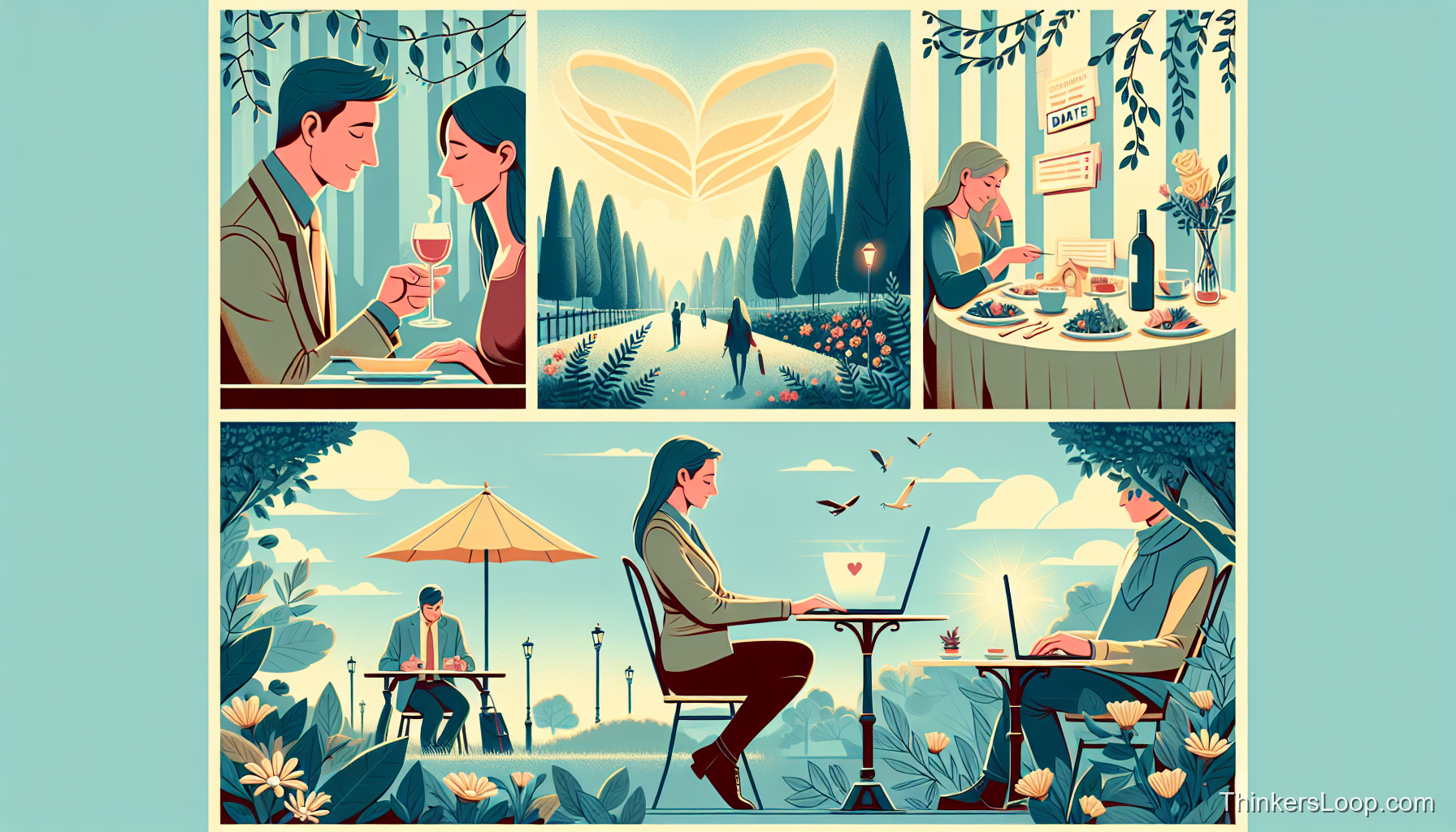
Dating culture was designed by extroverts. The standard first date — drinks at a bar, a conversation over background music, forty-five minutes of questions you’ve both answered a hundred times — produces approximately the worst conditions for an introvert to be at their best. You’re in a noisy environment, performing charm for a stranger, navigating small talk you find genuinely exhausting, and somehow supposed to project enough magnetic appeal that this person wants to see you again.
It’s a system that rewards quick wit, social ease, and comfort with surface-level interaction — none of which are introversion’s strong suits. What introverts actually bring to relationships — depth, genuine curiosity, the ability to make people feel truly seen in conversation — rarely shows up in the standard first date format. The problem isn’t introversion. It’s trying to compete in a format that doesn’t let introversion’s actual strengths emerge.
This article is about changing the format and the approach so that who you actually are has a chance to show.
In this article: Why standard dating formats disadvantage introverts · How to design dates that play to your strengths · Online dating as a genuine advantage · Managing energy and recovery around dating
Why Standard Dating Formats Disadvantage Introverts
Introversion, as Susan Cain’s research and writing helped clarify, is not shyness and not social anxiety — it’s a preference for less stimulating environments and a tendency to gain energy from solitude rather than social interaction. Introverts can be entirely socially skilled and genuinely enjoy meaningful connection; what drains them is specifically the high-stimulation, high-performance, low-depth social interaction that dating culture defaults to.
The conventional first date maximizes exactly the conditions introverts find most exhausting: unfamiliar environment, background noise that requires elevated effort to hear and be heard, an implicit expectation of sustained social performance with a stranger, and conversation constrained to the shallow end of what either person is actually interested in. In these conditions, an introvert’s warmth, depth, and genuine curiosity are typically invisible — replaced by a performance of social ease that feels inauthentic and exhausting.
Introverts don’t hate people. They hate performing for people. Given genuine conversation in a quiet environment with someone who’s actually interested in depth, they’re often the most compelling people in the room.
The solution is not to force yourself to perform better in the wrong format. It’s to change the format. Dating — especially in its early stages — is infinitely more customizable than convention suggests, and the format you propose communicates something about you before the date even happens: that you know what you like, that you’re thoughtful, and that you’re interested in an actual experience rather than a social audition.
Designing Dates That Play to Your Strengths
The best dates for introverts have two qualities: a built-in activity that reduces performance pressure, and enough quiet that genuine conversation is possible. These aren’t mutually exclusive with enjoyment — they’re actually the conditions under which most people have better first dates, introverted or not.
Suggest activity-based dates with a conversation component — a museum or gallery (built-in conversation fodder, lower pressure, can move at your pace), a walk in an interesting neighborhood (side-by-side conversation is often easier than face-to-face), a cooking class, a bookstore. These formats give both people something to respond to that isn’t each other, which reduces performance pressure and creates natural conversation without requiring you to manufacture it.
Timing also matters. Most introverts are more energized earlier in the day or after a period of solitude before the date. Scheduling dates at the end of a socially demanding day, when your social energy is already depleted, sets you up to present a flatter version of yourself than you actually are. Protecting some quiet time before a date — even 30 minutes alone — makes a measurable difference in how available you feel for connection.
Online Dating as a Genuine Introvert Advantage
The phase of dating that introverts often navigate best is online — which is genuinely fortunate given that this is now how most people meet. Written communication is introversion-native: you have time to think before responding, the conversation moves at your pace, and you can express yourself with the kind of depth and care that doesn’t translate well to rapid-fire in-person small talk.
Research on online communication and relationship formation consistently finds that written digital communication allows people to present themselves more accurately and thoughtfully than real-time oral communication — a finding that aligns directly with introversion’s natural strengths. Introverts tend to perform better in written than spoken first impressions.
The practical implication: take the online phase seriously as a genuine opportunity to show who you are, not just as a necessary hurdle before the real interaction. Write profiles and messages that actually reflect your voice and interests rather than what you think you should say. Ask questions that go beyond the surface. Give considered responses rather than one-liners. The person who emerges from a thoughtful online exchange is likely closer to who you actually are than the person who shows up nervous at a bar.
Having the Small Talk You Hate
Small talk is not the enemy — it’s the entry point. The problem isn’t that small talk exists; it’s treating it as the destination rather than the foyer. The skill introverts often need to develop isn’t eliminating small talk but moving through it efficiently toward the depth that actually interests them.
Small Talk as Destination
“What do you do?” → job description → polite interest → next surface question. This is the loop that exhausts introverts because it never goes anywhere. Nothing real is exchanged, nothing genuinely curious gets asked or answered, and you leave the conversation feeling like you talked for an hour without actually connecting with anyone.
Small Talk as Foyer
“What do you do?” → “What made you choose that direction?” → actual story → genuine interest → real conversation. The surface question is the same. The difference is the follow-up, which treats the answer as an entry point rather than a complete response. Introverts are often extraordinarily good at this — their natural curiosity about depth makes them unusually skilled at the follow-up question that takes a conversation somewhere real.
Managing Energy and Recovery
Dating takes energy, and for introverts, social energy is finite and requires deliberate replenishment. Treating this as a logistical reality rather than a character flaw changes how you approach a dating life. Scheduling too many dates in a row depletes the social energy that makes any individual date go well. Building in recovery time between social obligations isn’t antisocial — it’s how you show up present and genuine rather than exhausted and flat.
Introverts often make the mistake of overcommitting to dates because the commitment happens in advance, when energy is not yet depleted. Building a personal rule — no more than two social commitments per week, or always keeping Sunday evenings protected — creates the recovery structure that makes the dates you do have genuinely good rather than merely completed.
Being honest with a partner about needing recharge time — once things progress past early dating — is also worth doing sooner rather than later. The person worth being with will understand that needing an evening alone isn’t rejection. Discovering this early prevents the misunderstandings that arise when your introversion is invisible in the early stages and then suddenly visible when you’re depleted and need space.
Frequently Asked Questions
Should I disclose that I’m an introvert early in dating?
Not necessarily as a formal disclosure — but being honest about your preferences and pace is appropriate whenever it becomes relevant. “I prefer quieter environments” is a preference, not a vulnerability that requires disclosure. If your introversion significantly affects how you date — you need more recovery time, you prefer slower relationship progression, you’re not great in group social settings — those are worth being honest about when they become relevant, which is usually once you’re past the first few dates.
Are introverts better matched with other introverts?
Not necessarily — and the research doesn’t support a strong introvert-introvert pairing advantage. What matters more is mutual respect for each other’s social needs and compatible ideas about how social life should be structured. An introvert-extrovert pairing can work very well when the extrovert doesn’t require constant companionship and the introvert doesn’t require constant solitude — and when both understand each other’s energy needs without taking them personally.
How do I explain canceling plans because I need alone time?
Honestly and without over-explaining. “I’m genuinely looking forward to seeing you, but I’m running low on social energy this week and I think I’d be better company if we moved to [alternative date].” Most people respond well to honest, specific explanations that reaffirm interest while being clear about the need. “I need alone time” said plainly, without extensive justification, communicates self-awareness rather than disinterest to people worth being with.
What are the best dating apps for introverts?
Apps that reward thoughtful written communication over rapid swiping tend to suit introverts better — Hinge (with its prompt-based profiles) and apps that emphasize compatibility matching often work better than Tinder’s volume-based model. The specific app matters less than how you use it: taking time with your profile, writing considered messages, and using the written exchange phase to establish real connection before moving to in-person meetings. Introverts who use dating apps as a genuine opportunity for written self-expression rather than a logistics tool tend to have better experiences.
The Short Version
- The problem isn’t introversion — it’s the format — standard dating formats disadvantage introverts by maximizing performance pressure and minimizing the conditions where depth emerges
- Design dates with activity and quiet conversation — activity-based dates reduce performance pressure and create natural conversation without requiring you to manufacture it
- Online dating is an introvert advantage — written communication is introversion-native; use it as a genuine opportunity to show who you are
- Move through small talk, don’t avoid it — treat surface questions as entry points rather than destinations; your follow-up questions are your actual superpower
- Protect recovery time — scheduling too many dates without recovery depletes the energy that makes any individual date actually good
People Also Search For
dating tips for introverts · introvert first date ideas · how to date as an introvert · introvert social anxiety dating · best dating apps for introverts · how to make small talk as introvert · introvert extrovert relationship · dating exhaustion introvert · introvert communication style dating · quiet date ideas · deep conversation starters dating · introvert dating struggles
Sources
- Cain, S. (2012). Quiet: The Power of Introverts in a World That Can’t Stop Talking. Crown.
- Amichai-Hamburger, Y. (2002). Internet and personality. Computers in Human Behavior, 18(1), 1–10.
- Mehl, M. R., et al. (2010). Eavesdropping on happiness. Psychological Science, 21(4), 539–541.