
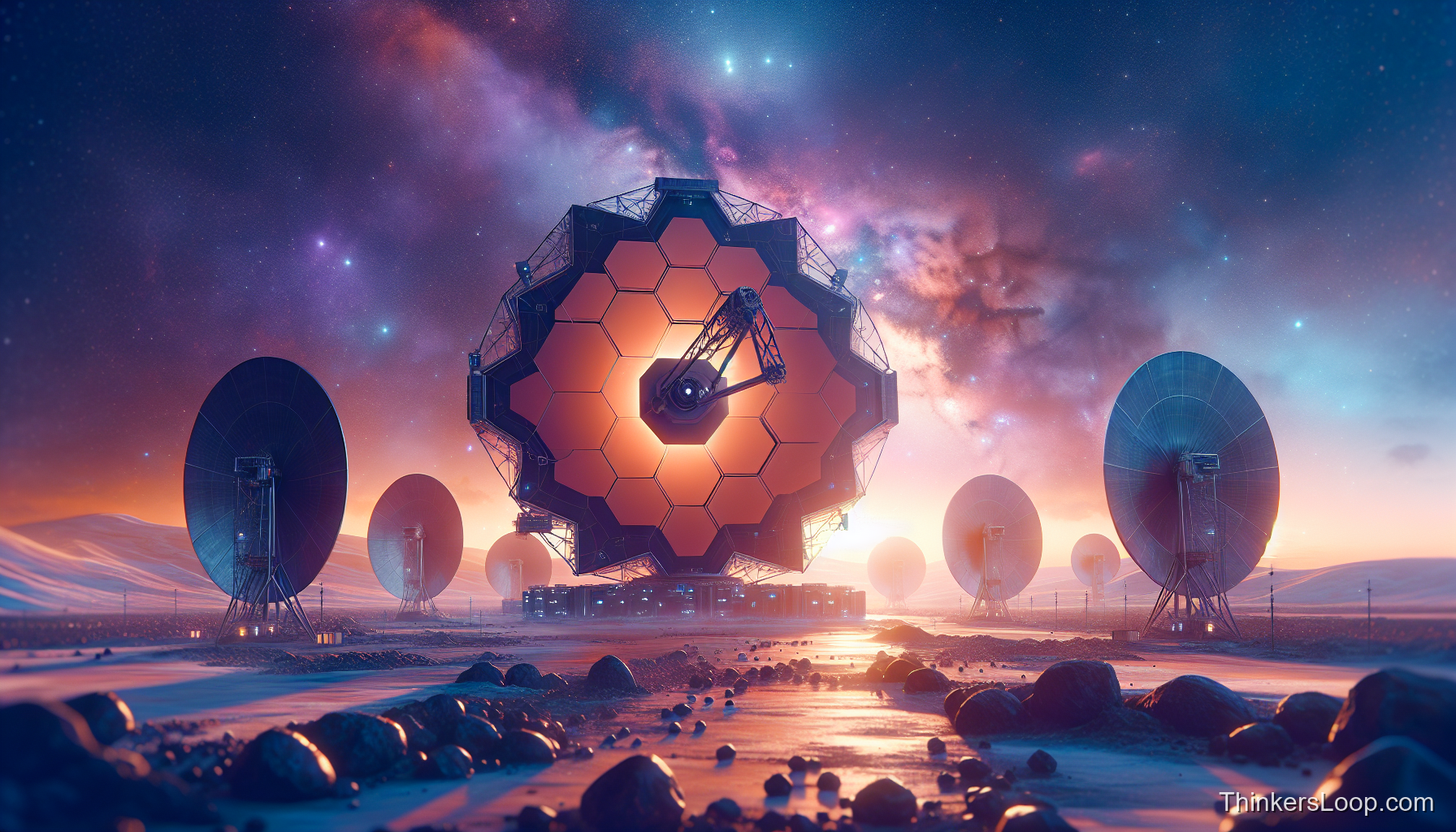
Quick take: When the James Webb Space Telescope began sending back its first images in mid-2022, astronomers expected gradual refinements to existing knowledge. Instead, JWST immediately began overturning assumptions about the early universe, revealing galaxies that should not exist yet according to prevailing models, and forcing a fundamental rethinking of how the first cosmic structures formed.
The James Webb Space Telescope cost roughly ten billion dollars and took over two decades to build. It required 344 single-point-of-failure deployments to unfold itself in the vacuum of space, any one of which could have ended the mission. When it finally reached its orbit at the second Lagrange point, 1.5 million kilometers from Earth, and began returning data, the scientific community held its collective breath. What JWST delivered was not just better pictures. It was a crisis for cosmological models that scientists had spent decades constructing.
Within its first year of operations, JWST discovered galaxies from so early in the universe’s history, and so unexpectedly massive and mature, that theorists scrambled to explain how they could exist. The telescope did not just push our vision further into the past. It revealed that our understanding of how the universe went from nothing to something was missing critical pieces.
Why Infrared Vision Changes Everything
To understand why JWST is so revolutionary, you need to understand redshift. As the universe expands, light traveling through space gets stretched. The further light has traveled, the more it has been stretched, shifting from visible wavelengths into the infrared. Light emitted as ultraviolet by the first stars 13 billion years ago arrives at Earth as infrared radiation. Hubble, which operates primarily in visible light, simply cannot see these signals. JWST was built specifically to capture them.
JWST’s primary mirror spans 6.5 meters, giving it roughly seven times the light-collecting area of Hubble. Its instruments operate at temperatures around minus 233 degrees Celsius, cold enough to detect the faint infrared glow from the universe’s earliest epochs. It also observes through dust clouds that block visible light, revealing stellar nurseries and galactic cores that were previously invisible. The combination of infrared sensitivity and enormous collecting area makes JWST the first telescope capable of directly observing the cosmic dawn.
JWST’s sunshield is roughly the size of a tennis court and provides a temperature differential of over 300 degrees Celsius between its sun-facing and space-facing sides. The cold side must remain below minus 233 degrees for the infrared detectors to function properly.
The Impossible Galaxies That Broke the Models
The most consequential early results from JWST involved the discovery of galaxies that appeared far too massive, too luminous, and too structurally organized to exist at the times they were observed. The prevailing Lambda-CDM model of cosmology predicted that galaxies in the first few hundred million years after the Big Bang should be small, faint, and chaotic. JWST found the opposite: some early galaxies had already assembled billions of solar masses worth of stars and displayed surprisingly ordered structures.
Several candidate galaxies initially appeared to challenge cosmology so severely that some astronomers questioned whether the observations were correct. Subsequent analysis confirmed many of these objects, though some redshift estimates were revised. The confirmed early massive galaxies remain difficult to explain. Star formation in these objects must have proceeded at rates far exceeding what standard models predict, suggesting either that early star formation was fundamentally more efficient than assumed or that our understanding of dark matter’s role in early structure formation needs revision. The implications connect directly to the equations that undergird our physics.
Not all early JWST galaxy claims have survived scrutiny. Some objects initially thought to be at extreme redshifts were later found to be closer dusty galaxies mimicking high-redshift signatures. Careful spectroscopic confirmation remains essential before drawing cosmological conclusions.
What Models Predicted
The Lambda-CDM model, supported by decades of observations, predicted that the earliest galaxies would be small, dim proto-galaxies gradually assembling over hundreds of millions of years through hierarchical merging. Massive, organized galaxies were expected to appear only after roughly a billion years of cosmic evolution, not within the first 300 to 500 million years.
What JWST Found
JWST revealed galaxies within the first 500 million years that were far more massive, bright, and structurally developed than expected. Some contained billions of solar masses in stars and showed disk-like morphologies, suggesting that early galaxy formation was dramatically faster and more efficient than hierarchical merging models predicted.
Rewriting the Story of the First Stars
Beyond galaxy formation, JWST is transforming our understanding of the first generation of stars, known as Population III stars. These hypothetical objects, formed from the pristine hydrogen and helium produced in the Big Bang with no heavier elements, have never been directly observed. Theory predicts they were enormously massive, perhaps hundreds of times the mass of our Sun, blazingly luminous, and short-lived. Their deaths in supernovae would have seeded the universe with the first heavy elements, enabling everything that came after.
JWST has not yet definitively detected individual Population III stars, but it has identified chemical signatures in early galaxies consistent with the enrichment patterns these primordial stars would have produced. Several deep field observations have also revealed candidate objects whose spectral properties are consistent with Population III star clusters. If confirmed, these would be among the most significant astronomical discoveries in decades, providing the first direct evidence of the objects that began the universe’s chemical evolution. Understanding how black holes form and grow is deeply connected to understanding these first stellar generations.
“JWST did not just push our view farther back in time. It showed us that the universe in its youth was far more precocious than anyone expected.”
Exoplanet Atmospheres and the Search for Life
While the deep-field discoveries have dominated headlines, JWST’s observations of exoplanet atmospheres may ultimately prove equally transformative. The telescope can perform transmission spectroscopy, analyzing starlight that passes through a planet’s atmosphere during transit to identify its chemical composition. JWST has already detected carbon dioxide, water vapor, and other molecules in the atmospheres of several exoplanets, including the rocky TRAPPIST-1 system planets.
The detection of biosignature gases, molecules like oxygen, methane, or phosphine that are difficult to produce without biological processes, in an exoplanet’s atmosphere would be among the most profound discoveries in human history. JWST has the sensitivity to detect some of these signatures in favorable targets, though confirming a biological origin will require ruling out abiotic explanations. This search directly intersects with what would happen if we discovered alien life, a question that grows more urgent with every JWST observation.
JWST detected dimethyl sulfide in the atmosphere of exoplanet K2-18 b, a molecule that on Earth is produced almost exclusively by marine phytoplankton. While not confirmed as a definitive biosignature, it demonstrates JWST’s ability to detect complex organic molecules in distant atmospheres.
What Comes Next and Why It Matters
JWST is designed to operate for at least 20 years, thanks to a nearly perfect insertion at L2 that conserved fuel far beyond expectations. Its observation queue is oversubscribed by a factor of roughly eight to one, meaning there are far more scientific questions waiting than the telescope can address. Priorities include deeper surveys of the earliest galaxies, continued characterization of exoplanet atmospheres, studies of supermassive black hole growth, and observations of star-forming regions within our own galaxy.
The broader significance of JWST extends beyond any individual discovery. It has demonstrated that our models of cosmic evolution, while remarkably successful in many respects, were incomplete in fundamental ways. Science works precisely because it can be wrong and correct itself. JWST’s greatest contribution may not be any single image or spectrum but the reminder that the universe is under no obligation to match our expectations, and that the most exciting discoveries come when observations force us to rethink what we thought we knew.
You can explore JWST’s raw data and processed images for free through the Mikulski Archive for Space Telescopes (MAST) at mast.stsci.edu. Many citizen science projects also allow non-specialists to contribute to the analysis of JWST data.
The Short Version
- JWST observes in infrared, allowing it to detect light from the earliest galaxies that Hubble could never see due to cosmological redshift.
- Early observations revealed galaxies far more massive and mature than models predicted, challenging core assumptions about how cosmic structures formed.
- The telescope is providing the first chemical clues about Population III stars, the primordial objects that seeded the universe with heavy elements.
- JWST’s ability to analyze exoplanet atmospheres has already detected complex molecules, bringing the search for biosignatures into the realm of practical science.
- With a projected 20-year lifespan and an oversubscribed observation queue, JWST will continue reshaping our understanding of the universe for decades.
Frequently Asked Questions
What makes the James Webb Space Telescope different from Hubble?
JWST observes primarily in infrared light, while Hubble operates mainly in visible and ultraviolet wavelengths. JWST’s primary mirror is 6.5 meters across compared to Hubble’s 2.4 meters, giving it roughly seven times the light-collecting area. This allows JWST to see farther, earlier, and through dust clouds that block visible light.
How far back in time can JWST see?
JWST has detected galaxies from approximately 300 to 400 million years after the Big Bang, pushing observations to within roughly 2 to 3 percent of the universe’s total age. These are the most distant and earliest objects ever observed, forming during the cosmic dawn when the first stars and galaxies were assembling.
Why were early JWST discoveries surprising to scientists?
Scientists expected the earliest galaxies to be small, dim, and irregular. Instead, JWST found galaxies that were far more massive, luminous, and structurally mature than models predicted. Some appeared to have formed stars and assembled their mass impossibly quickly given the time available, challenging existing theories of galaxy formation.
Where is JWST located in space?
JWST orbits the second Lagrange point, known as L2, approximately 1.5 million kilometers from Earth. At this gravitationally stable location, the telescope can keep its sunshield permanently between itself and the Sun, Earth, and Moon, maintaining the extreme cold its infrared instruments require.
James Webb Space Telescope discoveries, JWST early universe, cosmic dawn galaxies, infrared astronomy, exoplanet atmospheres JWST, Population III stars, Lagrange point L2, JWST vs Hubble