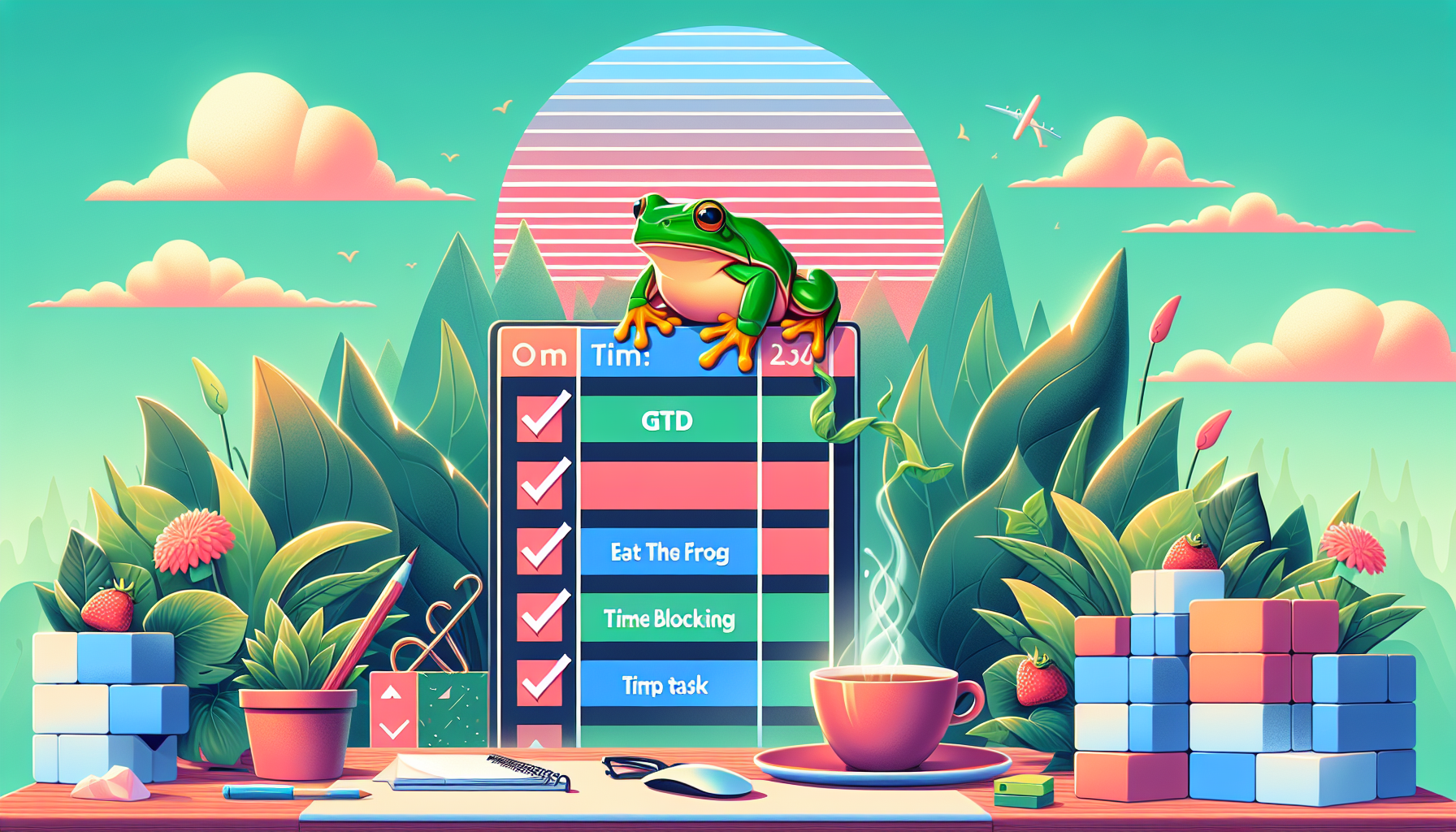
The sun has barely risen, and already your inbox is overflowing, your to-do list is a mile long, and your phone won’t stop buzzing. Sound familiar? This is the chaotic reality many of us face daily, where productivity frameworks like GTD, Eat the Frog, and Time Blocking promise salvation. These systems aim to bring order to the madness, helping you prioritize and execute your tasks with precision and ease.
But which one is truly the best fit for you? Each of these methods comes with its own philosophy, strengths, and potential pitfalls. Dive into this comparison to unearth which framework aligns with your work style and can transform your productivity from chaos to clarity.
The stakes are high. Choosing the right framework can mean the difference between a day spent spinning your wheels and one where you crush your goals with time to spare.
In this article: Comparing GTD · The power of “Eat the Frog” · Mastering Time Blocking · Choosing the right framework
GTD: The Ultimate Task Management System
David Allen’s GTD framework, introduced in 2001, remains the gold standard for task management. The principle is simple yet profound: your brain should generate ideas, not store them. By capturing every task and idea into an external system, you free up mental space for more creative and strategic thinking.
GTD’s strength lies in its comprehensive approach to capturing and organizing tasks.
The process involves five stages: capture, clarify, organize, reflect, and engage. While incredibly powerful when fully implemented, GTD can be overwhelming due to its complexity and the discipline required for regular reviews. For instance, tech companies like Microsoft and Accenture implement GTD to manage their large-scale projects efficiently, allowing teams to focus on innovation without being bogged down by task management.
Despite its benefits, GTD requires commitment. It demands a habit of regular reviews and updates to ensure that nothing slips through the cracks. In organizations where tasks change frequently, this could become a full-time job in itself. Yet, for those willing to invest the time, GTD offers a robust framework that can handle the most intricate workflows.
Eat the Frog: Beat Procrastination
Inspired by Mark Twain’s adage about eating a live frog first thing in the morning, Brian Tracy’s method urges you to tackle your most dreaded task first. This approach not only combats procrastination but also ensures that you use your peak cognitive hours for the most crucial work.
Decision fatigue diminishes your ability to make decisions as the day progresses. Tackling hard tasks early preserves your mental energy.
If you find yourself frequently postponing critical tasks, this method might be the key to unlocking greater productivity and peace of mind. Consider the example of Jack Dorsey, CEO of Square, who reportedly uses a similar approach to manage his dual CEO roles by prioritizing the most challenging tasks first thing every day.
However, “eating the frog” can be challenging if your hardest task isn’t clearly defined or if your schedule is unpredictable. Despite this, those who can identify their most significant task each day often find this method provides a straightforward path to increased productivity and reduced stress.
Time Blocking: Schedule Your Success
Time blocking transforms your task list into a structured schedule by assigning specific time slots to each task. This method helps eliminate decision fatigue by pre-deciding what you’ll work on and when.
Time blocking can dramatically reduce cognitive load, but it demands flexibility to accommodate unforeseen interruptions.
While time blocking can significantly boost productivity, it works best for those with control over their schedules and who can handle unexpected changes without stress. Elon Musk is known for his meticulous time blocking to manage his diverse ventures, ensuring that every minute is accounted for across Tesla, SpaceX, and other projects.
Despite its advantages, time blocking can become a source of frustration if your day involves frequent surprises or interruptions. The key lies in building buffer times within your schedule to accommodate the unexpected, allowing for flexibility while maintaining the structure.
Making Your Choice
So, how do you decide which framework suits you best?
GTD
Ideal for those with complex, multi-project roles who can dedicate time to maintaining a detailed system. GTD shines in environments where clarity and structure are necessary to manage competing priorities effectively.
Eat the Frog
Perfect if you struggle with procrastination on high-priority tasks and want a straightforward approach. This method is particularly effective for individuals looking to enhance focus and tackle critical tasks with immediate impact each day.
Time Blocking
Best for people with schedule autonomy who want to convert intentions into action through structured planning. This framework is ideal for those who appreciate a visually organized calendar to maintain control over their time.
Ultimately, the best productivity framework for you will depend on your personal work style, the nature of your tasks, and your willingness to adapt. Whether you’re managing multiple projects or looking to combat procrastination, understanding these frameworks can guide you to the productivity system that fits your life.
Frequently Asked Questions
Can I combine these frameworks?
Absolutely! Many find success using elements from multiple frameworks. You might start your day by “eating the frog” and then use time blocking for the rest of your tasks. Combining elements can often provide a more flexible and customized approach to productivity.
How do I maintain a GTD system without getting overwhelmed?
Start small. Implement the capture and clarify stages first, then gradually incorporate the other stages as you get comfortable. Keeping the system manageable and regularly reviewing your tasks can help prevent feeling overwhelmed.
Is time blocking too rigid for flexible work environments?
Time blocking can be adapted by including buffer periods to accommodate unexpected tasks or meetings that might pop up. By allowing for flexibility within your schedule, you can maintain control without sacrificing adaptability.
What if I don’t know which task to prioritize?
Use the Eisenhower Matrix to categorize tasks by urgency and importance. This can help you identify which “frog” to eat first or decide how to allocate your time blocks effectively.
The Short Version
- GTD — Comprehensive but high-maintenance; best for complex roles.
- Eat the Frog — Simple and immediate; focus on your hardest task first.
- Time Blocking — Converts tasks into a schedule; best with schedule control.
- Combine frameworks — Use aspects of each to suit different needs.
- Adaptability — Choose the simplest framework that addresses your bottlenecks.
People Also Search For
productivity tips · time management systems · GTD methodology · overcoming procrastination · effective scheduling · prioritization techniques · task management tools · flexible scheduling strategies · cognitive load reduction · maximizing productivity
Watch: Related Video
Sources
- Allen, D. (2001). Getting Things Done. Penguin Books.
- Tracy, B. (2001). Eat That Frog! Berrett-Koehler.
- Newport, C. (2016). Deep Work. Grand Central Publishing.