
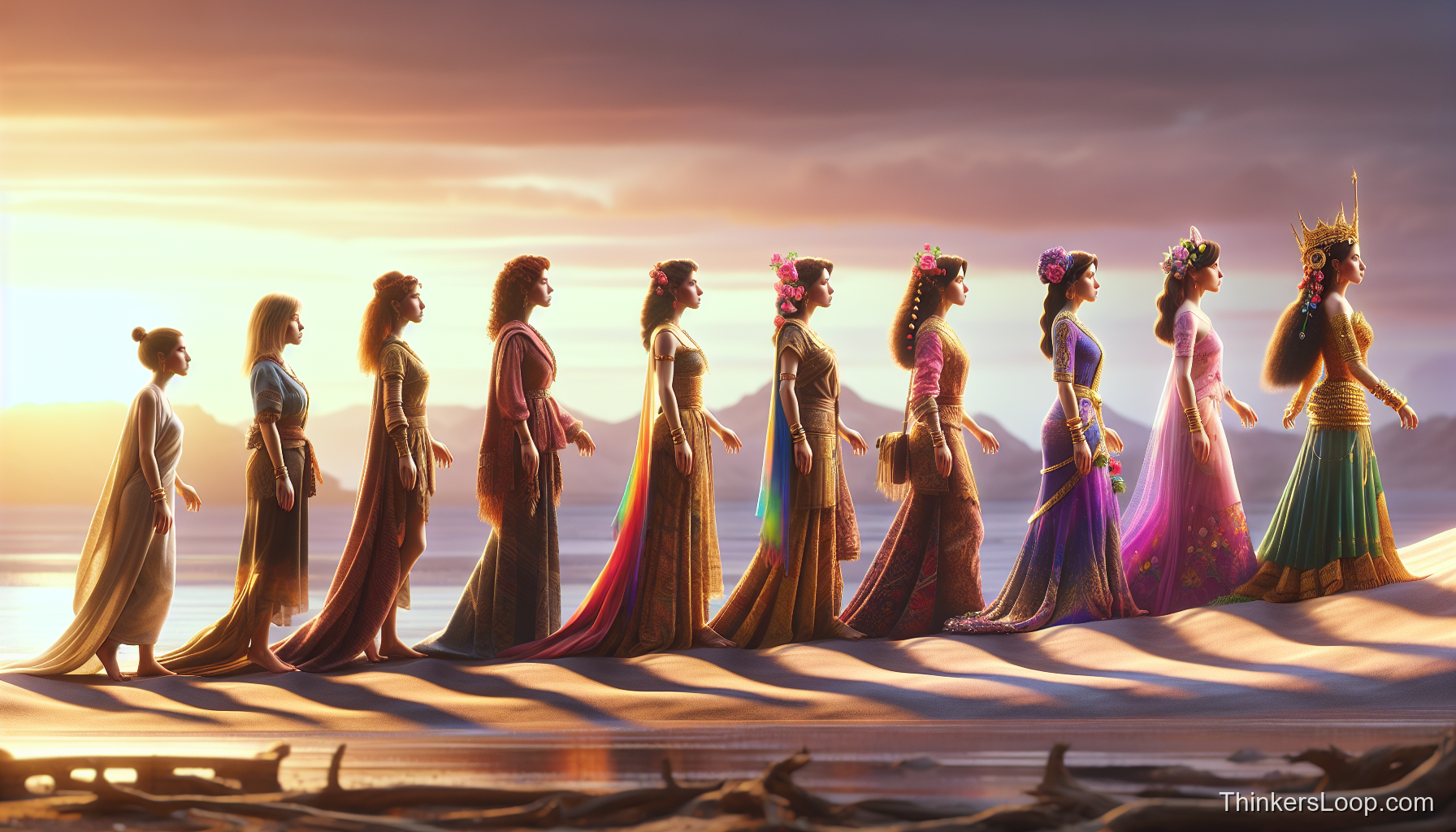
Quick take: The Disney princess has transformed dramatically over eight decades — from Snow White’s passive domesticity to Moana’s seafaring self-determination — and each reinvention maps directly onto the cultural anxieties and aspirations of its era. These animated heroines are not just entertainment; they are carefully calibrated reflections of what society believes girls should want, do, and become.
Few cultural artifacts have been as consistent in their reinvention as the Disney princess. Since Snow White debuted in 1937, the franchise has produced heroines across nearly every decade, and each one tells us something distinct about the moment that created her. The shifts are not accidental — Disney is a commercial enterprise finely attuned to audience expectation — but the cumulative arc reveals something genuine about how Western attitudes toward women, agency, and identity have evolved.
What makes the Disney princess particularly useful as a cultural lens is her ubiquity. These characters reach children during formative years and saturate popular culture in ways that more serious art rarely achieves. When the princess changes, it signals that the mainstream — not just the avant-garde — has shifted.
Snow White to Sleeping Beauty: The Postwar Ideal
Snow White (1937), Cinderella (1950), and Sleeping Beauty (1959) share a template so consistent it reads almost as doctrine: a beautiful young woman of gentle temperament is persecuted by a powerful older woman, endures through passivity and virtue, and is rescued by a prince whose love is the transformative event of her story. The heroines do not solve their problems — they wait for their problems to be solved. Their most celebrated qualities are physical beauty, sweetness, and domestic competence.
These films emerged from and reinforced postwar American ideals of femininity. The late 1930s through the 1950s was a period of overt domestic ideology, when women who had entered the workforce during the war were being encouraged back into the home. Snow White’s enthusiastic housekeeping for seven strangers, Cinderella’s uncomplaining servitude, and Aurora’s literal unconsciousness until a man kisses her are not accidents. They map onto a cultural script that celebrated feminine passivity and located female fulfilment in domestic life and marriage.
Snow White and the Seven Dwarfs was the first full-length cel-animated feature film in cinema history and the highest-grossing film of 1938. Its heroine was designed to embody what Walt Disney described as “the eternal feminine” — innocent, gentle, and beautiful. The casting of Snow White as a domestic caretaker for seven adult men was presented without irony, because the cultural frame of the era made it entirely legible as aspirational.
The Renaissance Heroines: A Partial Rewrite
The Disney Renaissance of the late 1980s and 1990s produced a new generation of princesses — Ariel, Belle, Jasmine, Pocahontas, and Mulan — who were visibly different from their predecessors. They had opinions, desires beyond marriage, and in several cases actively drove the plot rather than waiting to be rescued. Ariel wants adventure above the sea; Belle explicitly rejects the provincial life and the boorish suitor; Mulan disguises herself as a soldier and saves China. These heroines do things.
But the Renaissance heroines also operated within significant constraints. Ariel literally gives up her voice for a man. Belle falls in love with her captor. Jasmine’s plotline is still fundamentally about which man she will marry. Pocahontas’s character was built on a real historical figure and bears almost no resemblance to her documented life. The Renaissance heroines represent real progress — they are curious, spirited, and active — but they remain tethered to romantic resolution as the ultimate destination of their stories.
Belle from Beauty and the Beast is frequently cited as Disney’s first “bookish” heroine — a woman defined by intellectual curiosity rather than beauty alone. Her love of reading was intended as a progressive signal in 1991. But critics have noted that her narrative arc involves finding love with an abusive captor who controls her environment, which created a tension the film never fully resolved between its progressive surface and its more conventional romantic structure.
Frozen and Moana: The Agency Turn
The shift from Tangled (2010) through Brave (2012), Frozen (2013), and Moana (2016) represents the most significant structural change in Disney princess storytelling since the franchise began. These films did not merely update the heroine’s personality — they rewrote the plot itself. Brave ends with Merida refusing marriage entirely. Frozen’s climax is an act of sisterly love, not romantic love. Moana’s journey is explicitly about self-determination and cultural identity; she does not acquire a romantic partner at all.
These changes reflect a cultural moment that had grown visibly uncomfortable with the romance-as-resolution formula. The 2010s saw intensified public debate about gender representation in media, the rise of feminist criticism as mainstream discourse, and a generation of parents who had grown up with the Renaissance heroines and wanted something different for their children. Frozen became the highest-grossing animated film of all time at its release — suggesting that the audience for a different princess story was enormous and had been waiting.
When analyzing how Disney princess films reflect cultural change, it is worth distinguishing between what the films say intentionally and what they reveal unintentionally. The postwar heroines were not trying to make a feminist argument — they were trying to be appealing within the dominant values of their time. The gap between what a film intends and what it assumes is often where cultural analysis is most revealing.
Criticism, Representation, and What Progress Actually Looks Like
Progress in the Disney princess canon has been real but uneven, and criticism has been an important driver of change. The representation of race has improved significantly since the early films: Tiana (The Princess and the Frog, 2009) was Disney’s first Black princess, Moana centered Polynesian culture with genuine community consultation, and Raya and the Last Dragon (2021) featured a Southeast Asian-inspired heroine. These films represent meaningful efforts at inclusion, though critics have noted that Tiana spent most of her film as a frog, and that diversity in character design does not automatically translate to depth of cultural representation.
The criticism of Disney princesses from feminist scholars has itself evolved. Early criticism focused on passivity and the marriage plot. Later criticism shifted to body image — the unrealistic physical proportions that created harmful ideals. More recent criticism focuses on whether empowerment narratives have simply replaced passivity with a new kind of individual-achievement ideology, one that locates female value in being capable and impressive rather than beautiful and domestic, but still frames womanhood through a lens of performance and justification.
There is a risk of retrospective anachronism when evaluating historical Disney princesses by contemporary standards. Snow White in 1937 existed in a radically different cultural context, and judging her by 2024 values is less illuminating than asking what she tells us about 1937. The more interesting question is not “was this progressive?” but “what did this reflect and reinforce about its moment?” — which applies equally to contemporary heroines whose blind spots we may not yet be able to see.
The Disney princess doesn’t just reflect who women are supposed to be — she reflects who the culture needs women to believe they want to be. That’s a subtler and more powerful kind of influence.
What Future Princesses Might Look Like
The trajectory of the Disney princess suggests that future iterations will continue responding to the dominant cultural conversations of their moment. In an era of intensified focus on mental health, authentic identity, and the limits of individualist empowerment narratives, future princesses may be more explicitly concerned with vulnerability, community, and the complexity of self-knowledge rather than simply capability and determination. The shift from “princess who is saved” to “princess who saves herself” has been made — the next frontier may be “princess who needs other people and that’s not a weakness.”
There is also growing pressure on Disney to move beyond the princess framework entirely — to tell stories about girls and women that do not require royal birth, romantic destiny, or the word “princess” at all. Encanto (2021) and Turning Red (2022) suggest that Pixar and Disney are already doing this, producing female-centered stories entirely outside the princess convention. Whether this represents the evolution of the princess archetype or its eventual obsolescence remains to be seen.
Classic Era (1937–1959)
Heroines defined by beauty, passivity, and domestic virtue. Plot resolution through romantic rescue. Conflict driven by jealousy of older female figure. Marriage as unambiguous happy ending. Cultural context: postwar feminine domesticity ideal.
Modern Era (2010–present)
Heroines defined by agency, identity, and self-determination. Plot resolution through personal growth or collective action. Conflict driven by external threat or internal limitation. Romance optional or absent. Cultural context: feminist critique as mainstream discourse.
- Snow White, Cinderella, and Sleeping Beauty embody postwar domestic ideology — passive, beautiful heroines whose stories end in romantic rescue.
- Renaissance heroines (Ariel, Belle, Mulan) are more active and opinionated, but most remain tethered to romantic resolution as the climax of their stories.
- Frozen and Moana represent a structural shift — not just a new personality, but a new plot, in which sisterhood and self-determination replace romance as the central value.
- Representation of race has improved but remains uneven — diversity in character design does not automatically produce depth of cultural representation.
- Feminist criticism of the princess has itself evolved: from passivity to body image to the limits of individual-achievement empowerment narratives.
- Future princesses may focus on vulnerability and community rather than capability alone — reflecting growing cultural discomfort with individualist heroism.
Frequently Asked Questions
Are Disney princess films actually harmful to children?
The research is mixed and context-dependent. Some studies find short-term associations between Disney princess exposure and gender-stereotyped behavior in young children; others find that parent discussion of the films mediates any effect. The more supported concern is cumulative — not that any single film causes harm, but that a consistent cultural diet of narrow female archetypes shapes expectations over time. Critical engagement with media matters more than avoidance.
Which Disney princess is considered the most progressive?
Moana is frequently cited by media critics as the most fully realized modern Disney princess — she has a complete arc of self-discovery, her story does not involve romance, she is defined by cultural identity and personal determination, and her film was developed with extensive Polynesian community consultation. Mulan is also frequently mentioned for her active agency, though her film has faced criticism for its handling of Chinese cultural elements.
Why did Disney change the princess formula in the 2010s?
Multiple pressures converged: intensified feminist media criticism that became mainstream rather than niche, a generation of parents who had grown up with Renaissance heroines and wanted updated models for their children, commercial logic (Frozen’s record-breaking success demonstrated massive appetite for the new formula), and broader cultural shifts in how women’s stories were being told across film and television generally.
Do Disney princess films reflect or create cultural values?
Both, in a feedback loop. Films are made by people embedded in their cultural moment — they cannot help reflecting dominant values. Simultaneously, widely consumed media shapes the expectations and frameworks of children who grow up with it. The causality runs in both directions: culture produces these films, and these films reproduce culture. This is why changes in the princess formula matter — they are both symptoms of cultural change and contributors to it.
Disney princess evolution feminism, Snow White cultural analysis, Moana representation Polynesian, Frozen cultural impact gender, Disney princess body image criticism, Belle Beauty Beast feminist critique, Disney princess race diversity, animated heroines agency storytelling