
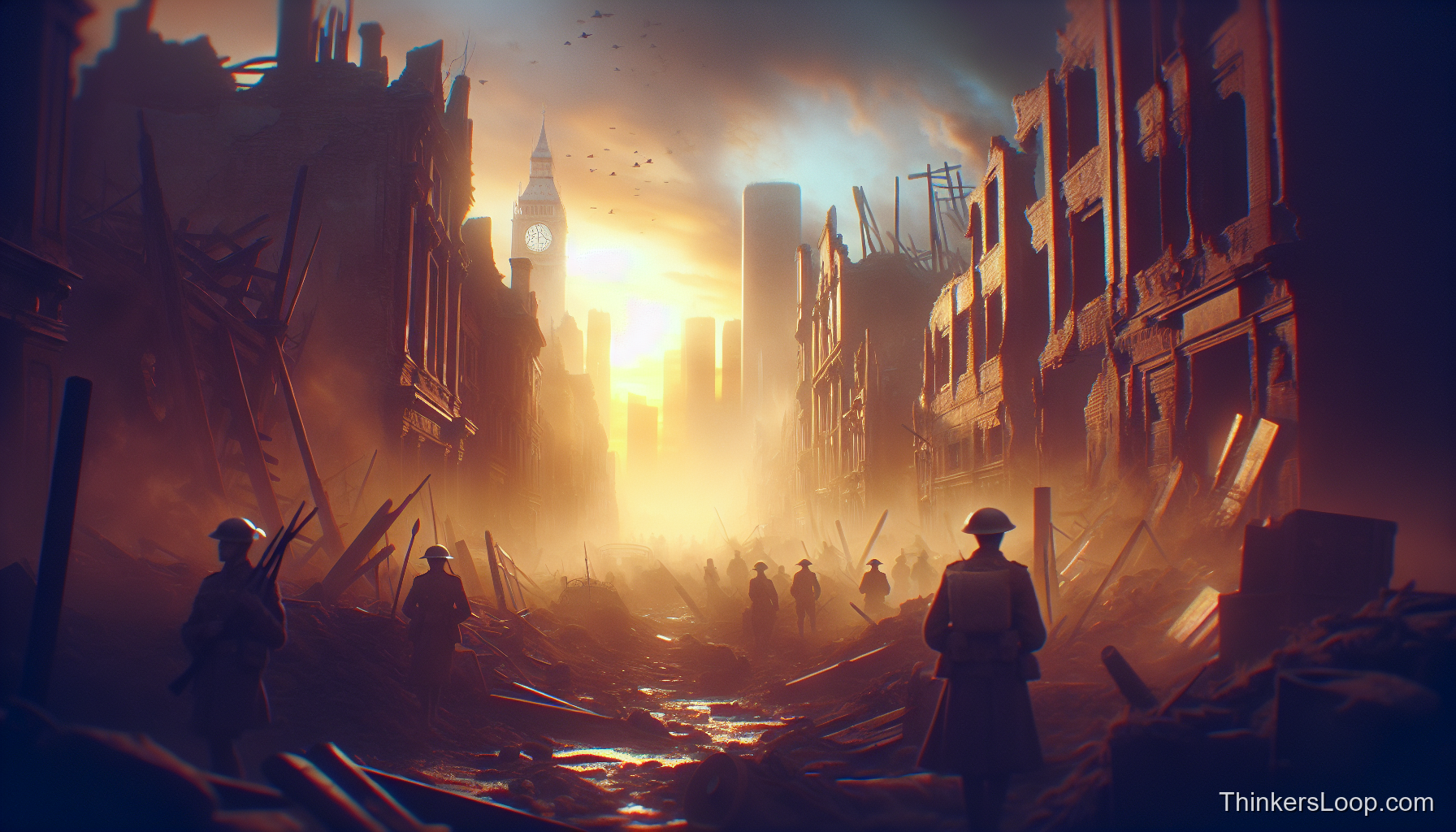
Quick take: Before 1914, most of the Western world still believed war was glorious, inevitable, and character-building. By 1918, that belief was buried alongside millions of soldiers in the trenches of France and Belgium. World War I did not just redraw maps — it permanently rewired how humanity understands armed conflict.
For centuries, war had been wrapped in mythology. It was where boys became men, where nations proved their worth, and where heroes were forged. The poetry of war was about honor, sacrifice, and glory. Generals rode on horseback. Soldiers marched in formation. And the public cheered as their sons departed for the front, certain they would return triumphant before Christmas. Then came the trenches, the machine guns, the mustard gas, and the horrifying realization that modern industrial technology had turned warfare into something no mythology could beautify.
What happened between 1914 and 1918 did not just kill an estimated 17 million people. It killed an idea — the idea that war was a noble human enterprise. And the aftershock of that death reverberates through every conflict, every military doctrine, and every anti-war protest that followed. Understanding the real story behind the Cold War requires understanding this seismic shift, because the Cold War’s logic of deterrence only makes sense in a world already traumatized by total war.
The Romantic Myth of War Died in the Trenches
Before 1914, European culture was saturated with heroic depictions of combat. The Napoleonic Wars had produced a century of military romanticism. War memorials celebrated fallen soldiers as paragons of virtue. Military service was the expected path for aristocratic young men, and the civilian public consumed stories of battlefield bravery with enthusiasm. When war was declared in August 1914, crowds gathered in the streets of London, Paris, and Berlin, celebrating what they assumed would be a short, decisive, and character-building contest between nations.
The Western Front dismantled that mythology with industrial efficiency. Soldiers found themselves trapped in muddy trenches stretching from the English Channel to Switzerland, facing machine guns that could fire 600 rounds per minute. A single day at the Battle of the Somme killed or wounded 57,000 British soldiers — more casualties in one morning than many previous wars had produced in their entirety. The gap between expectation and reality was not just large; it was psychologically devastating.
On the first day of the Battle of the Somme, July 1, 1916, the British Army suffered approximately 57,470 casualties, including 19,240 killed. It remains the bloodiest single day in British military history and became a symbol of the futility of industrial-era warfare tactics applied with pre-industrial assumptions.
The soldiers who survived carried their disillusionment home. Poets like Wilfred Owen and Siegfried Sassoon wrote verses that directly attacked the old lie — dulce et decorum est pro patria mori, it is sweet and fitting to die for one’s country. Their work was not merely literary protest; it was a fundamental challenge to the cultural infrastructure that had made the war possible in the first place.
Technology Outpaced Tactics — and the Human Cost Was Staggering
The central tragedy of World War I was the collision between 19th-century military doctrine and 20th-century killing technology. Generals trained in the Napoleonic tradition of maneuver warfare sent infantry advancing across open ground into machine gun fire, barbed wire, and pre-sighted artillery. The result was not warfare in any recognizable sense — it was mechanized slaughter. The tactical stalemate on the Western Front persisted for four years because neither side could solve the fundamental problem: defensive technology had leapt ahead of offensive capability.
This mismatch introduced something new to the human experience of war. Previous conflicts, however brutal, had a rhythm — advances, retreats, sieges, decisive battles. Trench warfare offered none of that. Soldiers lived for months in underground positions, subjected to constant bombardment, random death, and the psychological horror of watching friends die for gains measured in meters rather than miles. The war also introduced chemical weapons to the modern battlefield, with chlorine and mustard gas creating injuries so grotesque that even military commanders questioned their use.
The psychological damage of trench warfare was so widespread that the British Army alone recorded 80,000 cases of shell shock during the war. Military medicine had no framework for understanding psychological trauma on this scale, and many affected soldiers were initially accused of cowardice rather than recognized as casualties of a new kind of warfare.
War Before 1914
Cavalry charges and open-field maneuvers dominated strategy. Wars were typically short — weeks or months. Soldiers were celebrated as heroes, and combat was seen as a proving ground for masculine virtue. Civilian populations were largely shielded from direct conflict, and the public consumed romanticized accounts of battle through newspapers, poems, and paintings that emphasized glory over suffering.
War After 1918
Mechanized weapons, chemical agents, and entrenched positions made warfare a grinding, industrial process. Wars stretched into years. Veterans returned traumatized and disillusioned. Civilian populations became direct targets through strategic bombing and economic blockade. Anti-war literature replaced heroic narratives, and public opinion turned skeptical of government justifications for military action.
The Birth of Modern Propaganda — and Modern Skepticism
World War I was the first conflict in which governments deployed systematic propaganda on a mass scale. Britain created the War Propaganda Bureau, which recruited prominent writers and artists to produce material justifying the war effort. Germany, France, and the United States followed with their own propaganda operations. Posters, films, newspaper articles, and public speeches were carefully crafted to maintain civilian morale, encourage enlistment, and demonize the enemy. Understanding how propaganda works becomes especially important when you see how effective these WWI-era campaigns were at manufacturing consent for a war that produced no clear winners.
“The machinery of persuasion built during World War I did not disappear when the fighting stopped — it became the template for every government communication strategy that followed.”
The aftermath produced an equally powerful backlash. When veterans returned and the full scale of the carnage became public knowledge, trust in government narratives about war collapsed across much of Europe. The gap between what propaganda had promised — a clean, righteous, quickly won conflict — and what soldiers had experienced created a crisis of credibility that governments have struggled with ever since. Every subsequent war has been fought against a backdrop of public skepticism that did not exist before 1914.
This dynamic plays directly into understanding what made ancient civilizations collapse, because the erosion of institutional trust is a recurring pattern in societal decline — and WWI accelerated that erosion in the modern West like nothing before it.
Shell Shock and the Discovery of Psychological Warfare
Before World War I, the concept of psychological trauma from combat barely existed in medical or military thinking. Soldiers who broke down under fire were diagnosed with conditions like nostalgia or irritable heart, when they were diagnosed at all. Many were simply court-martialed for cowardice. The sheer volume of psychological casualties during WWI — tens of thousands of soldiers who could not stop shaking, could not speak, could not function — forced a reluctant military establishment to acknowledge that war damages minds as thoroughly as it damages bodies.
The term shell shock entered the lexicon as a catch-all for symptoms that ranged from uncontrollable tremors and nightmares to complete catatonia. Military hospitals filled with men who had no visible wounds but were clearly broken. The medical profession scrambled to understand what was happening, developing early theories of trauma that would eventually evolve into our modern understanding of PTSD. This was not a gradual academic development — it was a crisis forced by the scale of suffering.
Despite the recognition of shell shock during WWI, many affected soldiers received inadequate treatment or were stigmatized for decades afterward. It took until 1980 for Post-Traumatic Stress Disorder to be formally recognized in the Diagnostic and Statistical Manual of Mental Disorders, demonstrating how slowly military and medical institutions adapt to realities that soldiers have always known.
The Legacy That Shapes Every Modern Conflict
The intellectual and cultural aftershocks of World War I did not fade — they compounded. The Treaty of Versailles, designed to prevent future wars, instead created the conditions for an even more devastating one. The interwar period saw the rise of fascism in nations traumatized by the conflict, and the disillusionment of the 1920s and 1930s created fertile ground for authoritarian leaders who promised restored national glory. The path from the Somme to Auschwitz is not as long as we might wish it were.
Every military doctrine developed since 1918 has been shaped by the lessons of WWI. The emphasis on air power, mobile warfare, and avoiding static fronts — all of these emerged directly from the failures of trench warfare. The Geneva Protocol of 1925 banned chemical weapons in direct response to WWI atrocities. The creation of the League of Nations, and later the United Nations, reflected a world that had learned the catastrophic cost of great-power rivalry left unchecked. Even the fall of Constantinople and its reshaping of European geopolitics operated on a smaller scale than the global realignment WWI triggered.
If you want to understand any modern conflict — from World War II to Vietnam to the wars in Iraq and Afghanistan — start with the cultural and institutional changes that World War I produced. The assumptions, doctrines, and public attitudes that shaped those later conflicts were all forged in the trenches of 1914-1918.
The Short Version
- World War I permanently destroyed the romantic mythology of warfare that had dominated Western culture for centuries, replacing it with an understanding of war as industrialized trauma.
- The technological mismatch between defensive weapons and offensive tactics created an unprecedented stalemate that killed millions for negligible territorial gains.
- Government propaganda campaigns during WWI were effective in the short term but created lasting public distrust of official narratives about military conflict.
- Shell shock forced the medical establishment to recognize psychological trauma as a legitimate consequence of combat, eventually leading to our modern understanding of PTSD.
- Every major military, diplomatic, and cultural development since 1918 — from the Geneva Conventions to anti-war movements — traces directly back to the lessons and failures of World War I.
Frequently Asked Questions
Why is World War I considered a turning point in military history?
World War I introduced industrialized warfare on an unprecedented scale. Machine guns, poison gas, tanks, and aerial bombardment transformed combat from cavalry charges and open-field tactics into entrenched, mechanized slaughter. The sheer scale of death — over 17 million killed — shattered the romantic notion that war was a noble or glorious pursuit and permanently changed how nations approach armed conflict.
How did trench warfare change soldiers’ views on combat?
Trench warfare exposed soldiers to months of psychological torment — constant shelling, disease, mud, rats, and the knowledge that going over the top likely meant death. Veterans returned home with what was then called shell shock, now recognized as PTSD. Their firsthand accounts destroyed the idealized image of the warrior and introduced the concept of war as psychological trauma rather than heroic adventure.
What role did propaganda play in World War I?
Propaganda was used on a massive scale for the first time during WWI. Governments created entire departments dedicated to shaping public opinion, demonizing the enemy, and encouraging enlistment. The gap between propaganda’s promises and battlefield reality became one of the war’s most devastating legacies, fueling deep public distrust of government narratives about conflict.
How did World War I influence the anti-war movement?
The devastation of WWI gave birth to organized anti-war movements across Europe and America. Writers, poets, and veterans produced a wave of anti-war literature that remains influential today. The war also led to the creation of the League of Nations, the first major attempt at international peacekeeping, and established pacifism as a legitimate political position rather than a fringe ideology.
World War I impact on society, trench warfare history, shell shock PTSD origins, WWI propaganda, how WWI changed warfare, anti-war movement history, Battle of the Somme casualties, World War I legacy