
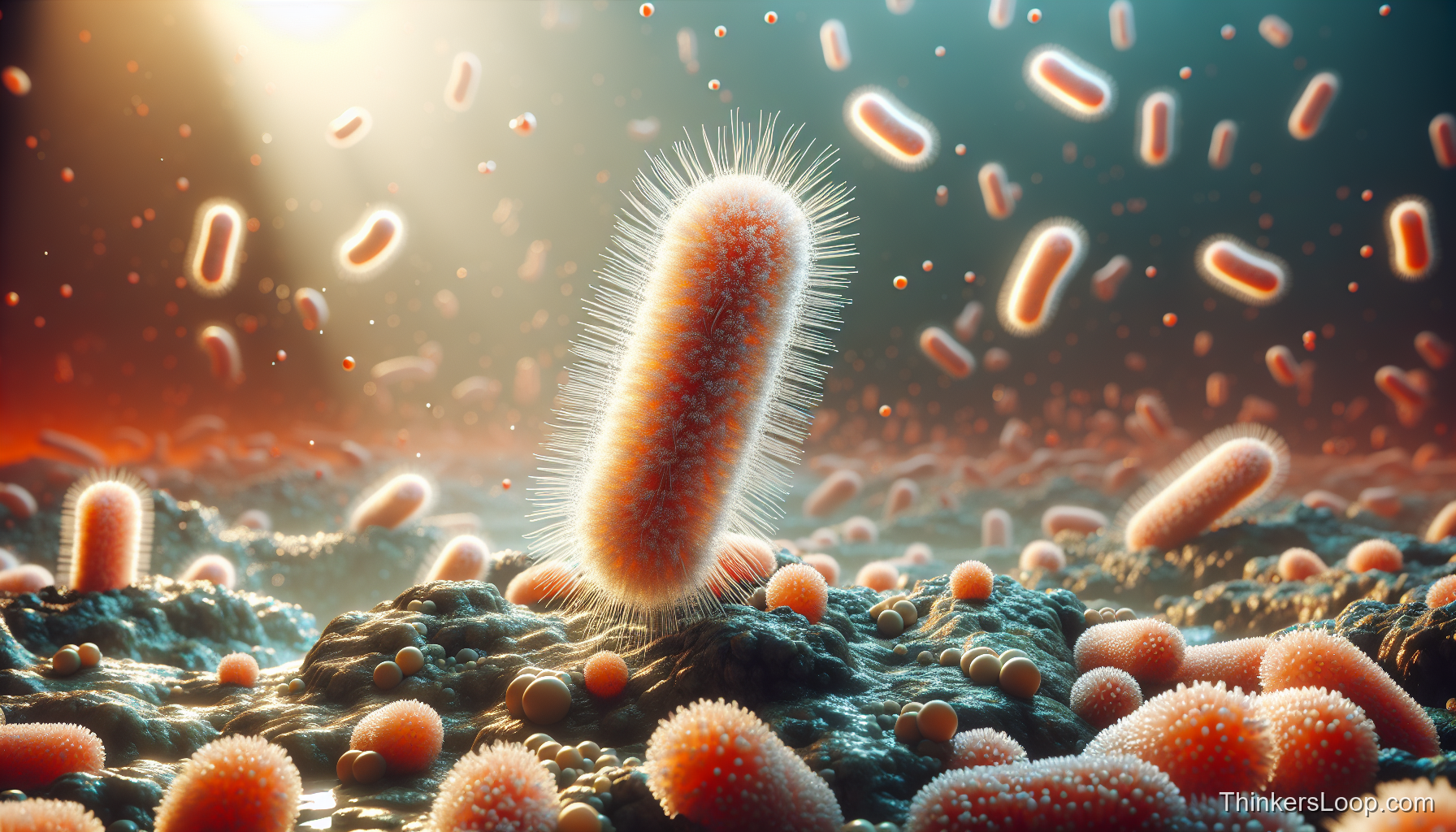
Quick take: Archaea are an entire domain of life hiding in plain sight. They look like bacteria but are genetically closer to you. They thrive in boiling acid and Antarctic ice. And growing evidence suggests that your own cells are descended from ancient archaea. If any group of organisms deserves more attention, it’s this one.
In biology class, you probably learned about two kinds of cells: prokaryotes (simple cells without a nucleus, like bacteria) and eukaryotes (complex cells with a nucleus, like yours). This clean division served well for over a century. Then, in 1977, microbiologist Carl Woese shattered the framework by showing that a group of microbes everyone had been lumping in with bacteria were actually something entirely different — as genetically distinct from bacteria as humans are.
He called them Archaea, and their discovery forced a complete rewriting of the tree of life. Yet four decades later, most educated adults have never heard of them. This is arguably the biggest blind spot in popular science education, because understanding archaea changes fundamental assumptions about what life is, where it can exist, and how it evolved into the complexity we see today.
Not Bacteria: A Completely Separate Branch of Life
Under a microscope, archaea look indistinguishable from bacteria — tiny, single-celled, no nucleus. This superficial resemblance is why they were classified as bacteria for over a century. But molecular analysis revealed that their RNA sequences, cell membrane chemistry, and DNA replication machinery are profoundly different. Archaea use ether-linked lipids in their membranes instead of the ester-linked lipids found in bacteria and eukaryotes — a biochemical difference so fundamental that it suggests the two groups diverged incredibly early in life’s history.
Their genetic machinery is, paradoxically, more similar to yours than to a bacterium’s. Archaeal DNA replication, transcription, and translation use proteins that closely resemble eukaryotic versions. This molecular kinship has enormous implications for understanding the deepest questions about life’s origins — specifically, how simple cells gave rise to the complex cells that eventually became animals, plants, and fungi.
When Carl Woese first proposed that archaea were a separate domain of life in 1977, the scientific establishment was hostile. Prominent microbiologists publicly ridiculed the idea. It took nearly two decades for the three-domain classification (Bacteria, Archaea, Eukarya) to gain widespread acceptance — a cautionary tale about scientific resistance to paradigm shifts.
Extremophiles: Life at the Edge of Possibility
Archaea first attracted attention because of where they live. Thermophilic archaea thrive at temperatures above 100°C in deep-sea hydrothermal vents. Halophilic archaea flourish in salt concentrations that would kill virtually any other organism. Acidophilic archaea grow happily at pH levels below 1 — more acidic than battery acid. These extremophiles redefined what biologists thought possible for living organisms.
But the extremophile label, while dramatic, has become misleading. In the past two decades, archaea have been found everywhere — in temperate ocean water, agricultural soil, freshwater lakes, and even the human gut and skin. They’re estimated to constitute up to 20% of Earth’s total microbial biomass. Far from being niche oddballs, they’re among the most successful organisms on the planet.
The hardiest known organism on Earth is an archaeon: Methanopyrus kandleri, which can reproduce at 122°C — well above water’s normal boiling point. It survives because it lives near deep-sea hydrothermal vents where extreme pressure keeps water liquid at these temperatures. This discovery expanded the theoretical temperature limit for life by over 10 degrees.
Bacteria
Ester-linked lipid membranes. Bacterial-type DNA replication machinery. Include both harmful pathogens and beneficial species. Cell walls typically contain peptidoglycan. Extensively studied with thousands of well-characterized species. Dominant in medical and industrial microbiology research.
Archaea
Ether-linked lipid membranes uniquely resistant to extreme conditions. Eukaryote-like DNA replication machinery. No known pathogens despite vast diversity. Cell walls lack peptidoglycan entirely. Relatively understudied with most species still uncharacterized. Increasingly important in evolutionary biology and astrobiology.
The Eukaryogenesis Connection: Your Archaeal Ancestry
Perhaps the most mind-bending finding about archaea is that you are probably descended from them. The leading theory of eukaryogenesis — how complex cells with nuclei evolved — proposes that an ancient archaeal cell engulfed a bacterium roughly two billion years ago. Instead of digesting it, the archaeon kept it as an endosymbiont. That bacterium eventually became the mitochondrion — the energy-producing organelle in every cell of your body.
“You are, in a very real sense, a modified archaeon walking around with bacterial power plants inside your cells. The merger that created complex life is written into every cell of your body.”
The discovery of Asgard archaea in 2015 supercharged this theory. Found in deep-sea sediments near Loki’s Castle hydrothermal vent field (hence their Norse-inspired names — Lokiarchaeota, Thorarchaeota, Odinarchaeota), these archaea possess genes previously thought exclusive to eukaryotes, including genes for cytoskeletal proteins and membrane-trafficking systems. They represent the closest known living relatives of the archaeal ancestor that gave rise to all complex life.
This means the evolutionary gap between simple and complex cells — long considered biology’s greatest discontinuity — is narrowing. Archaea are filling in the missing steps, transforming a mystery into a story we can actually begin to trace through deep time.
Archaea and the Search for Extraterrestrial Life
If life exists on Mars, Europa, or Enceladus, it probably looks more like archaea than anything else. The environments where extremophilic archaea thrive on Earth — volcanic hot springs, deep subsurface rock, ice-covered alkaline lakes — are precisely the environments we expect to find on other worlds. Astrobiologists use archaea as model organisms for understanding what extraterrestrial life might look like and how to detect it.
Mars in particular has conditions similar to habitats where methanogenic archaea thrive on Earth. The periodic detection of methane in Mars’s atmosphere — still unexplained — tantalizes researchers because methanogenic archaea are one of the few known biological sources of methane in anoxic environments. If Martian life exists, it would reshape our understanding of biology’s universality.
Don’t assume extremophile archaea are “primitive” organisms. Their ability to survive extreme conditions represents sophisticated biochemical adaptations, not simplicity. Some archaea have metabolic capabilities unmatched by any other domain of life, including the ability to directly use iron, sulfur, or even uranium as energy sources.
Why Archaea Still Don’t Get the Attention They Deserve
Despite their biological importance, archaea remain criminally understudied. The reasons are partly historical — they were misclassified for a century — and partly practical. Many archaea are extremely difficult to culture in the lab. Species from deep-sea vents require specialized high-pressure, high-temperature equipment. Some have generation times measured in months rather than minutes. This makes them expensive and slow to work with compared to model organisms like E. coli.
But the biggest reason is institutional inertia. Medical microbiology focuses on bacteria because bacteria cause disease. No archaeon is known to be pathogenic. Industrial microbiology focuses on bacteria and fungi because they produce antibiotics, enzymes, and fermented foods. Archaea’s most promising industrial applications — in biofuel production, bioremediation of toxic waste, and novel enzyme discovery for extreme conditions — are still emerging. As new technologies make studying them easier, expect archaea to become one of biology’s most active research frontiers.
If you’re a student considering a research career in biology, archaea represent an extraordinary opportunity. The field is young, most species remain uncharacterized, and the questions — about evolution, astrobiology, and novel biochemistry — are among the deepest in science. It’s one of the few areas where genuinely fundamental discoveries are still waiting to be made.
The Short Version
- Archaea are a separate domain of life, as genetically different from bacteria as you are despite looking identical under a microscope.
- They thrive in extreme environments but are also abundant in ordinary soil, ocean water, and even the human body.
- Growing evidence suggests eukaryotic cells — including yours — evolved from an ancient archaeal ancestor that merged with a bacterium.
- Asgard archaea, discovered in 2015, possess genes previously thought exclusive to complex life, bridging the gap between simple and complex cells.
- Archaea are central to the search for extraterrestrial life because they thrive in conditions most similar to other planets and moons.
Frequently Asked Questions
What are archaea?
Archaea are single-celled microorganisms that form one of the three domains of life, alongside bacteria and eukaryotes. Despite looking similar to bacteria under a microscope, they are genetically and biochemically as different from bacteria as you are. They were recognized as a distinct domain only in 1977.
Where do archaea live?
Archaea were first discovered in extreme environments — boiling hot springs, ultra-salty lakes, deep-sea hydrothermal vents, and highly acidic pools. But we now know they are everywhere: in soil, oceans, human gut, and even in the atmosphere. They are among the most abundant organisms on Earth.
Are archaea dangerous to humans?
No archaea are known to cause disease in humans or any other organism. This is remarkable given their abundance and diversity. Some researchers speculate that their unique cell membrane chemistry makes them incompatible with the mechanisms used by pathogens to infect hosts.
How are archaea related to humans?
Genomic evidence strongly suggests that eukaryotic cells — the type that make up all animals, plants, and fungi — evolved from an ancient merger between an archaeal host cell and a bacterial endosymbiont. In a very real sense, you are a modified archaeon walking around with bacterial power plants inside your cells.
archaea domain of life, extremophile microorganisms, Asgard archaea, eukaryogenesis, Carl Woese three domains, thermophilic organisms, astrobiology microbes, archaea vs bacteria